Sunday, 3 January 2010

Cushing's Syndrome in Pregnancy


Excellent Powerpoint on Cushing's syndrome


Aeitiology


(i)adrenal adenoma-disproportionately more common in pregnancy(40-50% Vs 17-19%)


(iii)ectopic ACTH


Clinical features

(I) Weight gain
(II) Hypertension
(III)Glucose intolerance
(IV)Purple striae

The above features aren't uncommon in pregnancy.

(V)Proximal myopathy


Changes in normal pregnancy


raised (i)total cortisol (ii)free cortisol levels (iii) urinary cortisol (iv) cortisol binding globulin

Corticotropin releasing hormone is secreted by placenta.


How does Cushing's Syndrome affects pregnancy?

(I) In untreated Cushing's syndrome hypothalamic pituitary axis is suppressed,so the patients tend to infertile.


(II) most common complications are hypertension & diabetes


(III) less frequent complications are osteoporosis,delayed wound healing and psychiatric complications


(IV) fetal complications -miscarriage,prematurity,intrauterine growth restriction & still births.


Maternal cortisol can cross the placenta.

(i)Increased rate of miscarriage
(ii)Premature delivery
(iii)Still birth


Investigations


Tests used for diagnosis

Pregnancy specific ranges should be examined


(i) 24 hour urinary free cortisol-Higher cutoff need to be used in pregnancy.


(ii)midnight serum cortisol -Physiological nocturnal drop is the serum cortisol level is also observed Cushing's syndrome.Higher cut off values should be used.


(iii)dexamethasone suppression test-


2 types of test


(A)overnight dexamethasone suppression test-1mg dexamethasone given at 23.00 hrs and serum cortisol is measured at 9am


(B)48 hour dexamethasone suppression test 0.5 mg given


6 hourly(9.00,15.00,21.00,3.00 hrs).Serum cortisol measured 9.00 at


the start & end of test.


The suppression effect on cortisol by dexamethasone is diminished in normal pregnancy.


So the usefulness of dexamethasone suppression is limited in pregnancy.


Once the Cushing's syndrome is confirmed, further tests done find the aeitiology.


If ACTH level is low adrenal imaging with MRI is useful.However adrenal' incidentaloma'(non secreting adrenal tumors can be found in 2-1% of abdominal CT's.It is important to correlate the CT findings to clinical & biochemical findings.

If ACTH level is elevated,high dose dexamethasone suppression test helps in differentiating between pituitary source vs ectopic ACTH.MRI of head or MRI of chest & abdomen can be arranged accordingly.


High dose of dexamethasone suppress cortisol in Cushing's disease but the suppression fails in adrenal adenoma & ectopic ACTH secretion.


ACTH measurement-ACTH level reduced in adrenal adenoma.


CRH (corticotropin releasing hormone) stimulation test-Pituitary tumors would show rise in cortisol but adrenal adenoma & Ectopic ACTH wouldn't.


Treatment

Multidisciplinary approach involving Obstetrician,Endocrinologist,Anaesthetist and Surgeon is important.

It's important to control the blood pressure and diabetes mellitus.


Definitive treatment options depend on aeitiology.
(I) Adrenal adenoma-Adrenalectomy
(II)Cushing's disease-Transsphenoidal treatment,Medical treatment or adrenalectomy.

adrenalectomy in Pitutary adenoma could lead to Nelson syndrome


(III)Ectopic ACTH-resection of the source.

medical treatment can be used but generally surgery is the preferred.

Medical treatment options

(I)cyproheptadine

(II)ketoconozole-This crosses the placenta,so there is a theoretical risk of inhibition of fetal adrenal cortex. Ketaconozole is also teratogenic in animal studies.

(III)metyrapone-can cause severe hypertension.

Medical treatment isn't currently recommended due to potential adverse side effects on fetus.


Post natal

(I) lactation is discouraged because

(a)there is possibility permanent galactorrhoea.

(b)drugs may be secreted into breast milk(ex.cyproheptadine)


(II) Neonate should be reviewed for potential intrauterine suppression of hypothalmic pituitary adrenal axis suppression.


References
(i) Cushing's syndrome in pregnancy: an overview.Vilar L, Freitas Mda C, Lima LH, Lyra R, Kater CE.
Arq Bras Endocrinol Metabol. 2007 Nov;51(8):1293-302.


(ii)Cushing syndrome in pregnancy .Deborah J. Cook, MD, FRCPC,Robert H. Riddell, MD, FRCPath,John D. Booth, MD, FRCPC. CMAJ, VOL. 141, NOVEMBER 15, 1989,pp1059-1061


(3)Nelson-Piercy C. Handbook of obstetric medicine. Taylor & Francis; 2002.

(4)Swiet MD. Medical disorders in obstetric practice. Wiley-Blackwell; 2002.

(5)Pituitary and adrenal disorders complicating pregnancy:Chandraharan, Edwin; Arulkumaran, Sabaratnam
Current Opinion in Obstetrics and Gynecology:April 2003 - Volume 15 - Issue 2 - pp 101-107

Thursday, 24 December 2009

Congenital adrenal hyperplasia in Pregnancy

Information on Congenital adrenal hyperplasia for Public

Congenital adrenal hyperplasia occurs as a result of gene mutation.

This results in defective glucocorticoid & mineralocorticoid synthesis.


Excellent Power point explaining congenital adrenal hyperplasia is here

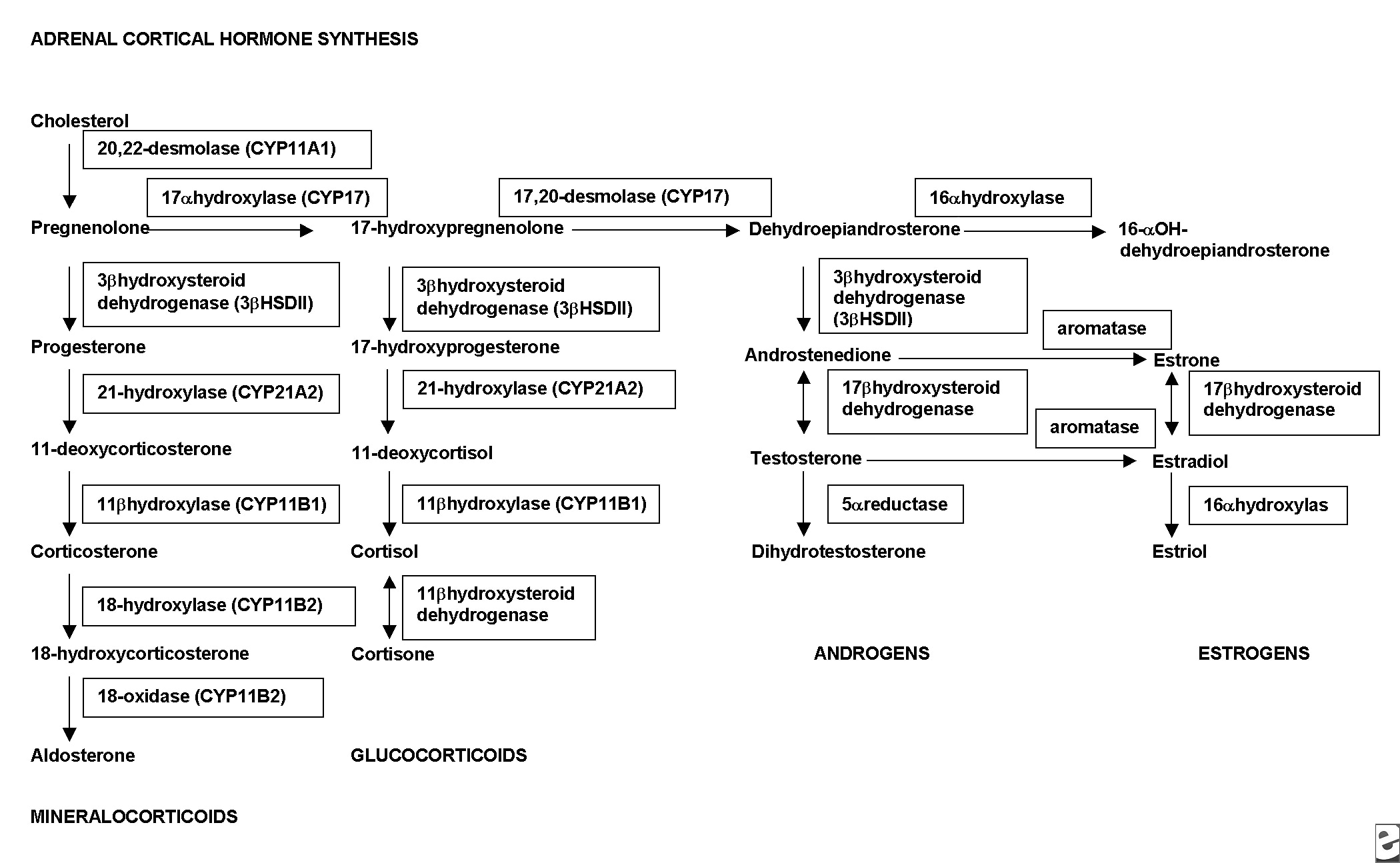
Diagram explaining adrenal hormone synthesis

Mode of inheritance is autosomal recessive.


Clinical features


3 catergories of diseasse - depending on the type of mutation

(I)Salt Wasting(SW)

(II) Simple Virilising(SV)

(III) Non-Classic(NC)


The condition is usually diagnosed in infancy


(A) Female infant-ambigious genetalia


(B)Acute illness due to hyponatraemia (salt losing crisis due to mineralocorticoid defeciency)

90% due to 21 hydroxylase enzyme deficiency.These patients have both glucocorticoid & mineralocorticoid defeciency.


5-8% due to 11 hydroxylase deficiency.These patients have excess deoxycortisol, that shows mineralocorticoid activity,leading to hypertension.

How the disease affect pregnancy?
(A)Reduction in fertility , especially in patients with salt wasting type disease.

Reasons: (i) inadequate control of hyperandrogenism
(ii)Inadequate introitus due to poor surgical repair

(B) Disease inheritance by fetus


(C) Risk of Miscarriage,pre-eclampsia & IUGR increased


(D) Masculinization can lead to android type pelvis that may lead to failure to progress in labour.

Management


Antenatal


2 Types of Clical problems


(I) Pregnant women with Congenital adrenal hyperplasia


(II)Women who is carrier for Congenital adrenal hyperplasia with previously affected child( or with a heterozygous partner)


Genetic counselling


(I) This is a autosomal recessive disorder.


(II)Prenatal diagnosis is possible with a battery of gene probes through chorionic villus sampling at 10 weeks


(III) In the past diagnosis made by estimation of 17 hydroxy progestrone & androgen levels in amniotic fluid.

(IV)Zygosity of partner for Congenital adrenal hyperplasia gene can be done.In case gene deletion ,30% of heterozygous , diagnosis can be made accurately.The other 70 % has gene mutation which can be mimicked by pseudo genes of normal individuals. So negative gene testing in the partner reduces the probability of heterozygosity from 1:50 to 1:70.


Differentiation of female genitalia occurs between 9-10 weeks,so even a diagnosis at 10weeks would be late in preventing masculinization of a female fetus with congenital adrenal hyperplasia.


Dexamethasone,the steroid which is capable of crossing the placenta, can be used to suppress the fetal adrenal gland to avoid masculinization. The therapy should be started at least by the fifth week.It may even be started preconceptually. This treatment regime isn't always successful in preventing masculinisation.


Maternal compliance is shown by reduced urinary cortisol or oestriol level.


If the chorionic villus sampling shows a female fetus with congenital adrenal hyperplasia(CAH), the treatment should be continued till delivery.In case of female fetus with congenital adrenal hyperplasia ,termination is also an option.


In a pregnancy with CAH in a male fetus or unaffected fetus the treatment should be discontinued.


Fetal sex determination by ultra sound scan is helpful as maternal androgen excess has minimal effects on male fetus.


Pregnant women with congenital adrenal hyperplasia
On the other hand some steroids can cause masculinization but patients need steroid to suppress their disease activity.However the placental aromatase activity is sufficient to prevent masculinization of fetus.

Hydrocortisone, cortisone acetate, prednisone, methylprednisolone are inactivated in the placenta but dexamethasone crosses the placenta and causes neonatal adrenal suppression.

Regular assessment of clinical status,serum electrolytes and serum androgen levels to adjust the glucocorticoid and mineralocorticoid therapy.


Generally the patients with 21-hydroxylase deficiency doesn't require alteration in dosage during pregancy.

Serum testosterone & free testosterone levels should me measured every 6 weeks in first trimester & every 8 weeks thereafter.Aim is to maintain free testosterone levels at high to normal levels for pregnancy.


Labour & delivery

Elective caesarean is indicated in patients who had genital reconstructive surgery.


Caesaren section rate among these patients is increased and this could be attributed to android type pelvis resulting from masculinization.


Stress dose glucocorticoid therapy ( Hydrocortisone 100 mg IM ) is indicated for patients undergoing labour.

Newborn should be examined for ambiguous genitalia.Female pseudohermaphroditism is either due to maternal hyperandrogenism or fetal 21 hydroxylase deficiency(if father is a carrier).


Affected fetuses would require steroid treatment but even the unaffted fetus would require short term steroid support when its adrenal activity is suppressed in utero as the result of treatment of mother.


Source

1.Nelson-Piercy C. Handbook of obstetric medicine. Taylor & Francis; 2002.

2.Swiet MD. Medical disorders in obstetric practice. Wiley-Blackwell; 2002.

3.1.E.Medicine

4.K. Hagenfeldt , P.O. Janson , G. Holmdahl , H. Falhammar , H. Filipsson , L. Frisén , M. Thorén , and A. Nordenskjöld
Fertility and pregnancy outcome in women with congenital adrenal hyperplasia due to 21-hydroxylase deficiency Hum. Reprod. Advance Access published on July 1, 2008, DOI 10.1093/humrep/den118.Hum. Reprod. 23: 1607-1613.


Tuesday, 1 December 2009

Artificial heart valve in pregnancy

Preconceptual evaluation

(A)
cardiac function should be assessed-Clinical/Echo/Exercise testing
moderately or severely symptomatic (class III and IV) should be advised against pregnancy

(B)Fetal risks-abortion/prematurity/intrauterine growth restriction/congenital abnormalities-due to warfarin/inheritance in patient's with congenital heart disease


Inheritance of congenital heart disease


(C)Anticoagulation should be discussed-if anticoagulation is altered there is an increased risk thromboembolism. If thromboembolism occurs during pregnancy the risk to the fetus increased again.

(D) management planned by multi disciplinary team(Obstetrician/cardiologist/Cardiothoracic surgeon)


2 major types of valves


1.mechanical- Suggested INR is 3-4.Failure to anti coagulate could result in valve thrombosis and stroke.Subcutaneous heparin anti coagulation may inadequate in patients with artificial valves.
three categories : caged-ball tilting-disc bi leaflet valves


2.bio prosthetic or homo graft-
three categories hetero grafts homo grafts auto grafts.

They don't require anti coagulation but shorter lives than mechanical valve.Patients may need anti coagulation if they develop Atrial fibrillation.

Opinion varies as to whether pregnancy accelerate homo graft valve deterioration.

Fetal risks of Warfarin
1.Miscarriage
2.Teratogenesis
Chodrodysplasia punctata
Optic atropy
Microcephaly

Factors determining the choice of anticoagulation
1.Site of valve replacement(mitral more thrombogenic aortic)

2.Type of valve ( ball & cage more thrombogenic than bi leaflet valves)

3.Past history of thromboembolic events

4.No of mechanical valves

5.patient choice


Anticoagulation regimens-3 broad possibilities

1.Warfarin throughout the pregnancy
2.Heparin & warfarin alternatively Heparin between 6-12 weeks & after 36 weeks
3.Heparin throughout the pregnancy

Aspirin is a useful adjunct when heparin is used.


If LMWH is used anti Xa levels should be monitored 4-6 hrs post injection.LMWH doesn't cross placenta

Advantages of LMWH

1.fewer bleeding complications
2.lower frequency of thrombocytopenia
3.lower incidence of osteoporosis
4.longer half life
5.more predictable dose response


The following is the commonly used regime


Conception is difficult to time & risk of congenital malformation is likely to be minimal in the first 4 weeks, so patient could conceive on warfarin.

Then patients are given intravenous heparin aiming to double APTT during 6-12 weeks.


Patient can be converted to warfarin from 12 weeks.

At 37 weeks patient us converted to continuous intravenous heparin.


If patients goes into labour while on warfarin vitamin K & FFP should be given & heparin should be commenced.
Heparin & LMWH can be reversed with protamine sulphate.

Postpartum patient continues on heparin for 3-7 days.Patient can breast feed while in heparin or warfarin.


Patients on dindevan shouldn't breast feed.


Antibiotic prophylaxis is indicated in patient with artificial valve.
Current recommendations amoxicillin 2g i.v & gentamicin 1.5 mg/kg i.v


Heart failure in pregnancy

medicine that can be used:digoxin, diuretics, nitrates, hydralazine, and
beta blockers.

medicine that should be avoided:angiotensin-converting enzyme
inhibitors and angiotensin receptor antagonist amiodarone sodium nirtotroprusside


Valve thrombosis in pregnancy

Thrombolysis is the first line approach
Surgery is reserved for patients in thrombolysis is contraindicated.

Patient information leaflet :Breast feeding while on anticoagulation

References

1.Nelson-Piercy C. Handbook of obstetric medicine. Taylor & Francis; 2002.


2.Swiet MD. Medical disorders in obstetric practice. Wiley-Blackwell; 2002.


3.Elkayam U, Bitar F. Valvular Heart Disease and Pregnancy: Part II: Prosthetic Valves. J Am Coll Cardiol. 2005 Aug 2;46(3):403-410.


4.The Seventh ACCP Conference on Antithrombotic and Thrombolytic Therapy

Evidence-Based Guidelines


Thursday, 26 November 2009

Mnemonic for Obstetric Haemorrhage

Management of Atonic Obstetric Haemorrhage-"HAEMOSTASIS"


General medical management

H-call for help

A-assess (vital signs/blood loss) & resuscitate

E-Establish aeitiology(4T-Tone/Tissue/ Trauma/Thrombin)

E-Ecbolics(syntometrine/ergometrine/bolus syntocinon)

E-Ensure availability of blood products

M-Massage the uterus

O-Oxytocin infusion,prostaglandins(intravenous,rectal,intramuscular,intramyometrial)


Specific surgical management

S-shift to operating theatre(bimanual compression anti-shock garment,especially if tranfer is required

T-Tissue & trauma to be exculded & balloon tamponade or uterine packing

A-apply compression sutures

S-sytematic pelvic devascularisation(uterine,ovarian,quadruple,internal iliac)

I-interventional radiology,uterine artery embolisation

S-Subtotal/Total hysterectomy

Source:

Mukherjee S, Arulkumaran S. Post-partum haemorrhage. Obstetrics, Gynaecology & Reproductive Medicine. 2009 5;19(5):121-126.


More Mnemoinics

Tuesday, 17 November 2009

Cystic fibrosis in Pregnancy

This is a multisystem disorder with impaired cellular secretion.
Commonest autosomal recessive disorder in U.K.
In Carrier rate 1:25 in Caucasians.In USA 1:30 American is a symptomless carrier.

Most common single mutation in Nonhispanic Caucasians is deltaF508.This occurs in approximately 65-70% of cases.DNA probes exist to detect 95% of mutations.If the couple already had a affected child,the defective gene could be identified and then prenatal diagnosis can be done to exclude cystic fibrosis.


Clinical features
1.recurrent lung infection/bronchiectasis/respiratory failure

2.pancreatic deficiency-malnutrition & diabetes.


Effect of Cystic fibrosis in Pregnancy
Fertility
Female: Fertility is reduced due to 1.thick cervical mucous 2.low lean body mass 3. voluntary infertility due to fear of producing affected children.

Male:
Most are infertile due to atresia of the vas & epididymis.

Pre pregnancy counselling

Factors to consider

1.cor pulmonlae

2.uncontrollable recurrent respiratory tract infection.

3.vital capacity - Patients with vital capacity less than 50% recommended termination.Many cystic fibrosis patients and patients with kyphosis with such vital capacity have normal pregnancy.

4.Right ventricular cavity size at end diastole is a good prognosticator of clinical outcome.

5.Patients may have diabetes and/or liver disease.Screening for diabetes need to be done.

6.Presence of Burkholderia cepacia is also an important risk factor.
Women's life span is reduced,so implications for parenting should be discussed.


Contraindication to pregnancy

1.Pulmonary hypertension
2.Cor pulmonale
3.FEV1 <30-40 class="ii gt">
Genetics
If father is a carrier-50% of babies wold be born with cystic fibrosis,other 50% would be carriers.

If father's carrier status unknown, the risk of CF baby is 2-2.5% as the carrier status is UK general population is 1:25.

Antenatal
1.risk of spontaneous abortion not increased.
2.complication in pregnancy
(A)prematurity
(B)IUGR-due to chronic hypoxia


Principles of antenatal management

1.antenatal screening- Power point on Cystic Fibrosis screening
2.support maternal nutrition
3.regular physio therapy
4.prevention & early treatment of infections.
5.avoid prolonged hypoxia
6.regular growth monitoring-Growth restriction can be managed by bed rest, nutritional supplements & oxygen.


Antibiotic treatment


Generally risk of infection is greater than the side effects of antibiotics.
Penicillin,cephalosporins and erythromycin are safe in pregnancy.
Tetracycline should be avoided.
Monitoring of drug levels should be done when intravenous aminoglycosides are used.
Data on new drugs like imipenam is limited.


The patient is managed by joined care between cystic fibrosis center & specialized obstetric center.


Screen for diabetes mellitus around 20 weeks


Presence of resting hypoxia(oxygen saturation 80-90%) is an indication for admission for bed rest & oxygen therapy.


Intrapartum


1.care with fluid & electrolyte as patients may easily become hyponatraemic & fluid overload should be avoided in corpulmonle.

2. epidural or caudal anaesthesia is preferred as there is risk post anaesthetic atelectasis.

3.risk of pneumothorax- be wary of chest pain

4.instrumental delivery could be used avoid prolonged second stage.


Postpartum
Breast feeding isn't contraindicated.Sodium & protein content of breast milk is normal.

Most medications used in the management of cystic fibrosis are safe in pregnancy.


Effect of pregnancy on disease

Pregnancy didn't affect the rate of annual decline in FEV1.


Sources
1.Nelson-Piercy C. Handbook of Obstetric Medicine, Second Edition. 2nd ed. Taylor & Francis; 2001.


2.Swiet MD. Medical Disorders in Obstetric Practice. 4th ed. Wiley-Blackwell; 2002.


Other sources


Article from Chest Journal

Another article